Brochures and guides
Image
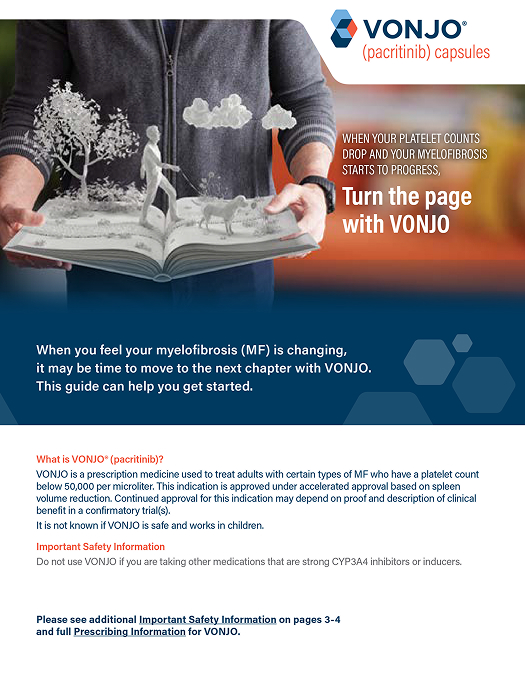
Patient brochure
A brochure to help you understand myelofibrosis and provide helpful information about how VONJO may help when platelet counts are low.
Image
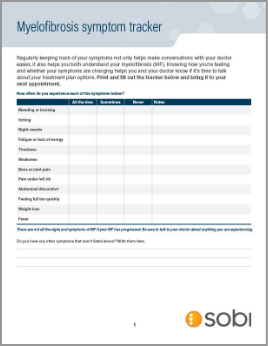
Symptom tracker
Use this symptom tracker to record your symptoms and how often they happen so you can have productive conversations with your doctor about your MF.
Videos
Image

Jennine’s Story: Finding the Right Care
Jennine, a real patient living with myelofibrosis, shares how VONJO became part of her treatment journey—and the importance of finding a myeloproliferative neoplasm (MPN) specialist who truly understands her.
Transcript
VO: VONJO or pacritinib capsules are a prescription medicine used to treat adults with certain types of myelofibrosis, or MF, who have a platelet count below 50,000 per microliter. This indication is approved under accelerated approval based on spleen volume reduction. Continued approval for this indication may depend on proof and description of clinical benefit in a confirmatory trial or confirmatory trials. It is not known if VONJO is safe and works in children.
Jennine: My name is Jennine. I'm 64 years old and I was diagnosed with myelofibrosis in 2021. I retired in 2018, and I worked as a medical assistant for a podiatrist for 37 years. I live with my husband and our youngest son. All together we have three sons and some very beautiful grandchildren. I love cooking, baking, walking the dogs. Life does have its challenges, but I do try to stay active and maintain a healthy lifestyle.
I was diagnosed with essential thrombocythemia, or ET, in 2011. My primary care physician noticed some abnormalities in my routine bloodwork, so she sent me to a hematologist. At that time, I wasn't feeling much different and wasn't experiencing any noticeable symptoms. I didn't know what to make of it. We then monitored things and I continued on with my life.
Then over the next few years, in 2016, it progressed to Polycythemia Vera or PV, and that's when the symptoms slowly started to creep in. I started getting more fatigued. I pushed through the long days of the clinic thinking I was just working too hard, or getting older, or taking care of my three sons.
Eventually, though, things were getting progressively worse. The fatigue was horrible. I had massive bruises on my arms, legs and even on my torso. I looked like I was beaten up. My spleen became so enlarged and even at the worst part, it felt as though it was half the size of my torso. The hematologist I was seeing retired, and he told me that I need more specialized care. Then when I started seeing Dr Rossetti, I was seeing him every few weeks.
Dr. Rossetti: Hello. My name is Dr. James Rossetti. I'm a hematologist in Pittsburgh, Pennsylvania, specializing in myeloid malignancies, including myelofibrosis.
We see many patients with myeloproliferative neoplasms or MPN’s, perhaps second opinions or involvement in more complex cases. I've been very fortunate to walk alongside many patients suffering with these chronic illnesses, but Jennine's story is one that really stands out to me and one I will never forget.
When Jennine first came to me in the summer of 2021, her myelofibrosis was already at a high-risk stage. Several cell lines were already low. She was feeling poorly, very tired, and had a poor appetite. Her spleen was significantly enlarged. She had already failed a prior therapy and had to discontinue another due to troubling side effects.
At that time, we were looking at one of two options moving forward. A trial drug called VONJO or a bone marrow transplant. I was very honest with Jennine stating that I was skeptical if any drug would help her disease for a long period of time. I told her that the likelihood is that we would be headed to bone marrow transplant fairly quickly.
VO: VONJO (pacritinib) capsules can cause the following serious side effects:
- Severe bleeding, which can be serious, and in some cases may lead to death. Stop taking VONJO and tell your healthcare provider right away if you develop any unusual bleeding, bruising, and fever. Get medical help right away for any bleeding that you cannot stop.
- Diarrhea is common with VONJO, but can be severe, and cause loss of too much body fluid (dehydration, which may cause kidney problems). Tell your healthcare provider if you have diarrhea and follow instructions for what to do if you get any symptoms of diarrhea (including taking an anti-diarrheal). Drink plenty of fluids to help prevent dehydration. Urgently seek emergency medical attention if diarrhea becomes severe.
- Worsening low platelet counts.
- Changes in the electrical activity of your heart called QTc prolongation which can cause irregular heartbeats that can be life-threatening. Tell your healthcare provider right away if you feel dizzy, lightheaded, or faint.
Get emergency help right away if you have any symptoms of a heart attack or stroke during treatment with VONJO. You may be at increased risk if you have cardiovascular risk factors, smoke or smoked in the past.
Tell your healthcare provider right away if you have any signs and symptoms of blood clots during treatment with VONJO.
There is a possible increased risk of new (secondary) cancers with VONJO. You may be at increased risk if you smoke or smoked in the past.
People who take VONJO may develop serious infections. If you have a serious infection, your healthcare provider may not start you on VONJO until your infection is gone. Tell your healthcare provider right away if you develop any symptoms of infection.
Please see additional important safety information at the end of this video.
Dr. Rossetti: That's the nature of myelofibrosis. It truly is a step-by-step journey. Jennine was feeling very poorly physically when she first came to me, but what really stood out to me was how mentally present she was. Her openness and courage laid a foundation for trust that followed.
Jennine: Early in our conversations, he told me about VONJO. He said, I'd like you to try this medication. It's a clinical trial drug, but there has been some promising data with it. He took the time to explain how it worked, what the early research was showing and what it could mean for someone in my situation.
Dr. Rossetti: I explained VONJO's trial design to Jennine. In a six-month clinical study, some people received 200 mg of VONJO twice a day and some people receive best available therapy or BAT, which included ruxolitinib, hydroxyurea, and monitoring without treatment. For people with low platelet counts, less than 50,000 platelets per microliter, 30% of people on VONJO had their spleen get at least 35% smaller compared to 3% of people on BAT. The most common side effects that occurred in more than 20% of people in the study were diarrhea, nausea, low platelet counts or thrombocytopenia, or low red blood cell counts, anemia and swelling of ankles, legs and feet.
Jennine: I remember asking him something very personal. I said, if this was your sister or your mother, what would you do? And without any hesitation, he said, this is exactly what I would do. I didn't know what to expect. I was really scared, but I knew I couldn't go on like this anymore. When I sat down with Dr Rossetti, he didn't just list the facts, he explained things in a way that felt grounded and honest. He gave me hope and something real to hold on to.
So I started VONJO in August 2021. From the beginning, I was monitored closely, regular bloodwork, check ins with my care team and lab works every week. It was slow going in the beginning, but over time I began to notice little shifts. The bruising started to fade, my appetite picked up. I didn't feel as fragile. The size of my spleen reduced. The fatigue was still there, but it wasn't crushing anymore. I could get through the mornings without needing to lie down. I started walking the dogs again. I could cook and bake and do small errands, and I wasn't just surviving the day, I was participating in it. Slowly, I started to feel like myself again. This is my experience with VONJO other people may react differently.
Dr. Rossetti: With Jennine, we have seen very encouraging clinical results. Many of the key parameters we follow, have shown improvement or have largely normalized. Her spleen size has reduced, her appetite has returned, her energy has increased, and we continue to monitor her blood counts.
But it truly wasn't just about the numbers. It was about Jennine telling me I walked the dog today or I played with the grandchildren. This is how I knew the drug was working. These functional changes in the life of someone with myelofibrosis really do matter.
Jennine: I still do get tired in the afternoons, but that part hasn't completely gone away. But now I know how to manage it. I rest when I need to. I pace myself, and I don't push too hard.
Living with the condition, like myelofibrosis, comes with a lot of unknowns. For me, it's important that my doctor sees me as a whole person, not just a diagnosis. I knew I needed someone who would take the time to listen, explain things clearly and involve me in every decision.
From the very first appointment with Dr. Rossetti, I felt something different. He sat down like he wasn't in a rush and asked how I was doing. Not just physically, but emotionally. That doesn't happen often, and it really stayed with me. It's not just about numbers from a lab result. It's about conversations, trust, and knowing your doctor understands what matters in your life. He's not only an expert, but I know he has my best interests at heart. I honestly can't say enough good things about him. He remembers things I told him months earlier, asks about my family and generally cares. I even get a hug from him when he walks in the room. That kind of human connection makes all the difference. It reminds you that you're not just a patient, you're a person. And he sees that. That's how we manage my myelofibrosis by talking about the whole picture together.
Dr. Rossetti: Jennine is the type of person you remember long after they leave the clinic. Jennine is deeply invested in her care, she comes prepared to office visits with notes and articles and written questions. At our first visit, she admitted that she didn't have a deep knowledge of the disease. Jennine brought her daughter-in-law, who is a nurse, to her first appointment. When you're talking about something as serious as transplant or clinical drugs, it's important to have someone with you. Someone that ensures that you both heard the same thing, or someone that can just help you remember what was said. Her daughter-in-law asked wonderful questions and continues to be an advocate for her today. This type of support is so important along your journey and cannot be overstated.
Jennine's experience highlights that treating patients with myelofibrosis is about much more than just managing a disease. It's about helping patients regain aspects of their lives. Her story is an example of what can happen when a patient finds the right treatment team. A team that works together. Your doctor should make you feel seen and see you as more than a diagnosis, but rather as a whole person. Life doesn't just stop because you have a diagnosis. Jennine and I have developed a partnership based on trust, empathy and transparency. It's a model for how healthcare should feel.
As I always tell patients, we want you alive and we want you living. Jennine has gotten to that place. She's feeling much more positive about where she is. You can see it in her face and in her demeanor. I couldn't be prouder of Jennine and more honored to be a part of her journey.
Jennine: When I think about where I was and where I am today, it feels like quite the journey. I've gone from being afraid to lose my independence to feeling much more in control.
My advice? Don't wait. Advocate for yourself. Ask questions, and don't be afraid to speak up. And most important of all, find a doctor who respects you and supports you. It's that type of relationship that can make all the difference. You need someone you feel safe with, who listens to you and fights for you. That's what I have in Dr. Rossetti. There is help out there. I'm not the same as before, and I feel like I've got more of my life back. VONJO helped me get there, and Dr. Rossetti helped me every step of the way.
VO: What is VONJO® (pacritinib)?
VONJO is a prescription medicine used to treat adults with certain types of myelofibrosis (MF) who have a platelet count below 50,000 per microliter. This indication is approved under accelerated approval based on spleen volume reduction. Continued approval for this indication may depend on proof and description of clinical benefit in a confirmatory trial(s).
It is not known if VONJO is safe and works in children.
Important Safety Information
Do not use VONJO if you are taking other medications that are strong CYP3A4 inhibitors or inducers.
What are the serious side effects of VONJO?
Bleeding. VONJO can cause severe bleeding, which can be serious and, in some cases, may lead to death.
- Stop taking VONJO and tell your healthcare provider right away if you develop any of these symptoms: unusual bleeding, bruising, and fever. Get medical help right away for any bleeding that you cannot stop
- You will need to stop taking VONJO 7 days before any planned surgery or invasive procedure (such as a heart catheterization, stent placement in a coronary artery in your heart, or a procedure for varicose veins). Your healthcare provider should tell you when you can start taking VONJO again
Diarrhea. Diarrhea is common with VONJO, but can be severe, and cause loss of too much body fluid (dehydration, which may cause kidney problems). Tell your healthcare provider if you have diarrhea and follow instructions for what to do if you get any symptoms of diarrhea (including taking an anti-diarrheal). Drink plenty of fluids to help prevent dehydration. Urgently seek emergency medical attention if diarrhea becomes severe.
Worsening low platelet counts.
Changes in the electrical activity of your heart called QTc prolongation. QTc prolongation can cause irregular heartbeats that can be life-threatening. Tell your healthcare provider right away if you feel dizzy, lightheaded, or faint.
Increased risk of major cardiovascular events such as heart attack, stroke, or death in people have happened, especially in those who have cardiovascular risk factors and who are current or past smokers taking another Janus associated kinase (JAK) inhibitor to treat rheumatoid arthritis.
Get emergency help right away if you have any symptoms of a heart attack or stroke during treatment with VONJO, including: discomfort in the center of your chest that lasts for more than a few minutes, or that goes away and comes back; severe tightness, pain, pressure, or heaviness in your chest, throat, neck, or jaw; pain or discomfort in your arms, back, neck, jaw, or stomach; shortness of breath with or without chest discomfort; breaking out in a cold sweat; nausea or vomiting; feeling lightheaded; weakness in one part or on one side of your body; or slurred speech.
Increased risk of blood clots. Blood clots in the veins of your legs (deep vein thrombosis, DVT) or lungs (pulmonary embolism, PE) have happened in some people taking another JAK inhibitor for rheumatoid arthritis and may be life-threatening.
Tell your healthcare provider right away if you have any signs and symptoms of blood clots during treatment with VONJO, including: swelling, pain, or tenderness in one or both legs; sudden, unexplained chest pain; or shortness of breath/difficulty breathing.
Possible increased risk of new (secondary) cancers. People who take another JAK inhibitor for rheumatoid arthritis have an increased risk of new (secondary) cancers, including lymphoma and other cancers, except non-melanoma skin cancer. The risk of new cancers is further increased in people who smoke or have smoked in the past.
Risk of infection. People who have certain blood cancers and take another JAK inhibitor have an increased risk of serious infections. People who take VONJO may develop serious infections, including bacterial, mycobacterial, fungal, and viral infections. If you have a serious infection, your healthcare provider may not start you on VONJO until your infection is gone. Your healthcare provider will monitor you and treat you for any infections that you get during treatment with VONJO.
Tell your healthcare provider right away if you develop any of the following symptoms of infection: chills, aches, fever, nausea, vomiting, weakness, painful skin rash, or blisters.
Tell your healthcare provider about all the medicines you take, including prescription and over-the-counter medicines, vitamins, and herbal supplements and remedies. Taking VONJO with certain other medicines may affect the amount of VONJO or the other medicines in your blood and may increase your risk of side effects or affect how well VONJO works.
Especially tell your healthcare provider if you take hormonal contraceptives (birth control). Hormonal birth control methods, except for intrauterine systems containing levonorgestrel, may not work during treatment with VONJO and for 30 days after your last dose. Talk to your healthcare provider about birth control methods that may be right for you during treatment with VONJO.
Your healthcare provider may change your dose or how often you take VONJO, temporarily stop, or permanently stop treatment with VONJO if you have certain side effects.
Do not interrupt or stop VONJO treatment without consulting with your physician. If you stop treatment, symptoms of your condition may return. If you need to stop treatment with VONJO, your healthcare provider may give you instructions for slowly stopping treatment. Tell your healthcare provider right away if you experience any of the following signs and symptoms after stopping treatment with VONJO:
- fever
- trouble breathing
- feeling dizzy or lightheaded
- weakness
- night sweats
- pain in your left upper stomach (abdomen) area or left shoulder
What should I tell my healthcare provider before starting VONJO?
- Have active bleeding, have had severe bleeding, or plan to have surgery or noninvasive procedures. You should stop taking VONJO 7 days before any planned surgery or invasive procedures
- Have diarrhea or commonly have loose stools
- Have had a blood clot, heart attack, other heart problems, or stroke
- Have a history of low blood levels of potassium. It is important that you get blood tests done during
- treatment with VONJO to monitor your body salts (electrolytes)
- Smoke or were a smoker in the past
- Have had any other cancers
- Have an infection
- Have nausea or vomiting
- Have liver or kidney problems
- Are pregnant or plan to become pregnant. It is not known if VONJO will harm your unborn baby
- Are breastfeeding or plan to breastfeed. It is not known if VONJO passes into your breast milk. You should not breastfeed during treatment and for 2 weeks after your last dose of VONJO. Talk to your healthcare provider about the best way to feed your baby during this time
What are the most common side effects with VONJO?
Low platelet count (thrombocytopenia), nausea, vomiting, low red blood cell count (anemia), and swelling of your ankles, legs, and feet.
Your healthcare provider will do blood tests and an electrocardiogram (ECG) before you start treatment with VONJO and as needed during treatment to check for side effects.
VONJO may affect fertility in males. You may have problems fathering a child. Talk to your healthcare provider if this is a concern for you.
These are not all of the possible side effects with VONJO.
If you suspect that you have experienced a side effect, call your healthcare provider. You may also report side effects to the US Food and Drug Administration (FDA) at 1-800-FDA-1088.
Please see the full Prescribing Information for VONJO at www.VONJO.com.
Image

Teri's Story: The Power of Support
Teri, a real patient, opens up about her experience living with myelofibrosis and VONJO, and the impact her caregiver's support has had throughout her journey.
Transcript
VO: VONJO or pacritinib capsules are a prescription medicine used to treat adults with certain types of myelofibrosis, or MF, who have a platelet count below 50,000 per microliter. This indication is approved under accelerated approval based on spleen volume reduction. Continued approval for this indication may depend on proof and description of clinical benefit in a confirmatory trial or confirmatory trials. It is not known if VONJO is safe and works in children.
Teri: Hi, I'm Teri. I'm 65 years old. I was diagnosed with myelofibrosis in 2021 post polycythemia vera. I'm retired after 45 years in dentistry, Six years ago, my husband and I left California, and we moved here to Arizona I take care of my elderly parents who followed me over here, and I spent a lot of time with them and my daughter and my grandchildren.
I love being out in the garden when I can get my gardens going and I spent a lot of time in my chicken coop with my chickens. I have a dog that I totally adore and love, and I think the feeling is mutual. I'm also the co-leader of the 4H Club in Prescott, Arizona, 4H is the largest youth led organization in America. I do as much as I can to stay busy and to live my life to the fullest.
Aubrey: I'm Aubrey, I'm Teri's daughter. I'm her caregiver, and I moved here with my two daughters from California to Arizona to be closer to my mom.
Teri: My journey with myelofibrosis has not been one that's been straightforward. My symptoms began back in 2001 with a lot of chronic fatigue and persistent pain. I was diagnosed with fibromyalgia, chronic fatigue syndrome, Epstein-Barr. I had a lot of IVIg transfusions and iron infusions.
In 2015, the abdominal pain had gotten so bad that my GI doctors and my liver specialists decided that they needed to send me to a specialist hospital in the Midwest to determine whether or not I had cancer. I was diagnosed with Polycythemia Vera. In 2015, I started on hydroxyurea after being at the clinic in the Midwest and I returned back to California.
In 2017, I was still living in California, and I had switched oncologists doctors again to someone who was better equipped to handle an MPN. So the treatment was to continue on hydroxyurea, along with IVIg treatments and iron. We started considering places to move, and Arizona has a specialized clinic here. When I moved here to Arizona, I had pretty much chosen the clinic that I was going to go to, on their website, I was then able to go to all the oncology specialists who dealt with MPNs. I found one that I was comfortable with and scheduled an appointment, and I've been with him ever since. We did a bone marrow biopsy to get a baseline of what was happening here. He decided at that time that the numbers did not match up to what they had been for a couple of years prior. So he switched me over to type one interferon injections along with the warfarin treatment.
When the Covid 19 pandemic hit, all of my appointments subsided just like everybody else's. My symptom load had also progressed a lot more bone pain, a lot more abdominal pain. Another biopsy showed that I had progressed to myelofibrosis, and that was in 2021. Which was a difficult diagnosis to accept and, one of the reasons for that is because my doctors had always said that this disease of having an MPN was a very slow progression, and I hadn't been diagnosed for that long. I really had a difficult time because we had just moved here to Arizona just a few years before, and pretty much starting into our retirement years of being able to enjoy travelling. I wasn't so much afraid of dying as it was the progression of how fast it was.
My doctor and my team had decided to put me on a trial medication which unfortunately did not go so well for me, and it caused me to have a lot of side effects that landed me in the hospital multiple times with multiple transfusions.
Aubrey: The progression to where she is now was hard. All the progressions up to this point have been pretty gentle. And then this last the last big one was downright scary. Calling 911 for the ambulance to come get you in. I had to fight with her to get her to the hospital, and literally fight for her life in the hospital because they were giving you the wrong medications. Um, a lot of the doctors just don't know what an MPN is. Having to tell doctors to go look up the MPN website and research this cancer that we were battling and advocating for you loudly, very, very loudly. You weren't in a position to advocate for yourself.
Teri: Yeah.
Aubrey: So they got me.
Teri: Thankfully, I taught you well. And so it's very important that you have an advocate with you, uh, to explain those things when you can't. Nowadays, we know a lot more about what an MPN is, and as patients, we know a lot more about our diseases.
After this, my doctor switched me to a Jak inhibitor, but I didn't tolerate it. My doctor recommended VONJO. I’ve always had low platelets, and he also stated that it could help with my spleen size by reduction. And that’s when I started VONJO in 2023.
VO: In a six-month clinical study, some people received 200 mg of VONJO twice a day and some people receive best available therapy or BAT, which included ruxolitinib, hydroxyurea, and monitoring without treatment. For people with low platelet counts, less than 50,000 platelets per microliter, 30% of people on VONJO had their spleen get at least 35% smaller compared to 3% of people on BAT. The most common side effects that occurred in more than 20% of people in the study were diarrhea, nausea, low platelet counts or thrombocytopenia, or low red blood cell counts, anemia and swelling of ankles, legs and feet.
VO: VONJO (pacritinib) capsules can cause the following serious side effects:
- Severe bleeding, which can be serious, and in some cases may lead to death. Stop taking VONJO and tell your healthcare provider right away if you develop any unusual bleeding, bruising, and fever. Get medical help right away for any bleeding that you cannot stop.
- Diarrhea is common with VONJO, but can be severe, and cause loss of too much body fluid (dehydration, which may cause kidney problems). Tell your healthcare provider if you have diarrhea and follow instructions for what to do if you get any symptoms of diarrhea (including taking an anti-diarrheal). Drink plenty of fluids to help prevent dehydration. Urgently seek emergency medical attention if diarrhea becomes severe.
- Worsening low platelet counts.
- Changes in the electrical activity of your heart called QTc prolongation which can cause irregular heartbeats that can be life-threatening. Tell your healthcare provider right away if you feel dizzy, lightheaded, or faint.
Get emergency help right away if you have any symptoms of a heart attack or stroke during treatment with VONJO. You may be at increased risk if you have cardiovascular risk factors, smoke or smoked in the past.
Tell your healthcare provider right away if you have any signs and symptoms of blood clots during treatment with VONJO.
There is a possible increased risk of new (secondary) cancers with VONJO. You may be at increased risk if you smoke or smoked in the past.
People who take VONJO may develop serious infections. If you have a serious infection, your healthcare provider may not start you on VONJO until your infection is gone. Tell your healthcare provider right away if you develop any symptoms of infection.
Please see additional important safety information at the end of this video.
Teri: It's been over two years now that I started VONJO I feel pretty good and we're keeping an eye on things. My doctor and I continually check my blood levels monthly. My spleen enlargement has reduced and I have a lot less pain in the abdominal area. I do have some side effects from the medication, but they're manageable. My platelet counts are still on the low side, which can contribute to my fatigue. I pace myself as much as I can during the day. Take a nap when I need to, but overall, I can handle where I'm at, and if I feel off at all I message my doctors at the clinic.
VONJO has given me some consistency in my life back, and I'm able to enjoy the smaller things in my life. I know this is not a cure, but it is helping me to live day to day with some consistency, and at this point in my journey, I have a lot to look forward to and that means a lot. This is just my experience. It's important to discuss your myelofibrosis symptoms with your doctor.
Aubrey: I luckily live only about three miles away, and I'm happy to put eyes on my mom every day. I've slid into the caregiver role, which my mom always was up to this point. We've slid into a generational shift in roles.
It's a very different way that I interact with my mom now. It's not a bad way. It's just very, very different. I go over to her house every single day and put eyes on her, usually for coffee. That's our excuse.
I check on her, make sure she's taking her meds. Sometimes she forgets and question her if she's still in bed, why she's on the couch. And then I get really invasive. Have you been outside today? Have you eaten today? How much water have you had? Have you had anything to drink? I can have a different kind of conversation with her than pretty much anyone else in our lives. She knows if I'm calling her Teri, there's a reason for it. And it's far more serious than anything else.
As we prepare for her doctor's appointments, that drive consists of mom, pull up the list because I'm usually driving. Uh, what are we talking about today? Is there anything else we need to add? And then, while we're in lunch between labs and her appointment, we'll get her labs. We'll talk about them. It's not uncommon to find one of us researching something number wise on her labs before we head into the appointment.
Teri: I'm very blessed and grateful that I have Aubrey. Our bond has deepened since my diagnosis. We've always been close, but this has brought us closer. My granddaughters pitch in too, and they help me with the animals and fixing meals and caring for my parents.
Aubrey: They've been amazing. We all help lift the load off of mom so she can focus on her health. She still does too much, including planning for vacations and prom for my oldest daughter and including volunteering for the girls 4-H club here that's local. Even the 4H kiddos have a nickname for her. It's Ms Nana lady.
I'm very proud of my mom. A lot of times nobody knows that she's sick because this illness doesn't show on the outside. Most days, most people are pretty shocked that she's facing an illness. Even the people that know tend to forget that she's dealing with cancer. So when she doesn't make it to an event or something that we're doing, I have to re explain what's happening. It turns into a proud moment for me. Most days she just deals with it, doesn't let it slow her down. The diagnosis is not defining her life.
We do have the hard times. Luckily, we have sarcasm and humor to make us laugh and get through all of our difficult times. Lots of giggles. That's how we process things instead of tears. On the other hand, we're both very methodical and we just add new plates to our life and keep everything in the balance. It's not been easy.
Teri: My journey has been full of twists, but every step has led me to where I am today. I had misdiagnosis, setbacks, and treatments that have failed. But I've also learned so much from this journey.
There's so much more knowledge about it than there was ten years ago. And I think there's a lot more that the patients need to understand. There will be things that doctors recommend, and they may be hard decisions, but they won't be the answer for everyone. You have to choose what's right for you. The unknown is the hard part, but you deal with it as it comes.
Aubrey: If someone is going through a similar journey, I would say ask the questions. No question is too small. It's okay to ask the same question a hundred times, even if you don't understand that same question. This month may have a different answer next month. There are a couple of questions that I ask pretty regularly over and over again, and I don't stop asking until they finally make sense. Knowledge is power and it can lead to better care. You just have to keep asking those questions. Sometimes those same questions lead the doctor to go look in a different direction at something different. Trust your gut and find your way, even in the hardest moments.
Teri: Before VONJO, there were a lot of treatments that did not work for me, but I kept going. Now I enjoy my life and my grandkids. If sharing my story helps just one person, then it's all been worth it. Thank you for watching and letting us share our story.
VO: Important Safety Information
Do not use VONJO if you are taking other medications that are strong CYP3A4 inhibitors or inducers.
What are the serious side effects of VONJO?
Bleeding. VONJO can cause severe bleeding, which can be serious and, in some cases, may lead to death.
- Stop taking VONJO and tell your healthcare provider right away if you develop any of these symptoms: unusual bleeding, bruising, and fever. Get medical help right away for any bleeding that you cannot stop
- You will need to stop taking VONJO 7 days before any planned surgery or invasive procedure (such as a heart catheterization, stent placement in a coronary artery in your heart, or a procedure for varicose veins). Your healthcare provider should tell you when you can start taking VONJO again
Diarrhea. Diarrhea is common with VONJO, but can be severe, and cause loss of too much body fluid (dehydration, which may cause kidney problems). Tell your healthcare provider if you have diarrhea and follow instructions for what to do if you get any symptoms of diarrhea (including taking an anti-diarrheal). Drink plenty of fluids to help prevent dehydration. Urgently seek emergency medical attention if diarrhea becomes severe.
Worsening low platelet counts.
Changes in the electrical activity of your heart called QTc prolongation. QTc prolongation can cause irregular heartbeats that can be life-threatening. Tell your healthcare provider right away if you feel dizzy, lightheaded, or faint.
Increased risk of major cardiovascular events such as heart attack, stroke, or death in people have happened, especially in those who have cardiovascular risk factors and who are current or past smokers taking another Janus associated kinase (JAK) inhibitor to treat rheumatoid arthritis.
Get emergency help right away if you have any symptoms of a heart attack or stroke during treatment with VONJO, including: discomfort in the center of your chest that lasts for more than a few minutes, or that goes away and comes back; severe tightness, pain, pressure, or heaviness in your chest, throat, neck, or jaw; pain or discomfort in your arms, back, neck, jaw, or stomach; shortness of breath with or without chest discomfort; breaking out in a cold sweat; nausea or vomiting; feeling lightheaded; weakness in one part or on one side of your body; or slurred speech.
Increased risk of blood clots. Blood clots in the veins of your legs (deep vein thrombosis, DVT) or lungs (pulmonary embolism, PE) have happened in some people taking another JAK inhibitor for rheumatoid arthritis and may be life-threatening.
Tell your healthcare provider right away if you have any signs and symptoms of blood clots during treatment with VONJO, including: swelling, pain, or tenderness in one or both legs; sudden, unexplained chest pain; or shortness of breath/difficulty breathing.
Possible increased risk of new (secondary) cancers. People who take another JAK inhibitor for rheumatoid arthritis have an increased risk of new (secondary) cancers, including lymphoma and other cancers, except non-melanoma skin cancer. The risk of new cancers is further increased in people who smoke or have smoked in the past.
Risk of infection. People who have certain blood cancers and take another JAK inhibitor have an increased risk of serious infections. People who take VONJO may develop serious infections, including bacterial, mycobacterial, fungal, and viral infections. If you have a serious infection, your healthcare provider may not start you on VONJO until your infection is gone. Your healthcare provider will monitor you and treat you for any infections that you get during treatment with VONJO.
Tell your healthcare provider right away if you develop any of the following symptoms of infection: chills, aches, fever, nausea, vomiting, weakness, painful skin rash, or blisters.
Tell your healthcare provider about all the medicines you take, including prescription and over-the-counter medicines, vitamins, and herbal supplements and remedies. Taking VONJO with certain other medicines may affect the amount of VONJO or the other medicines in your blood and may increase your risk of side effects or affect how well VONJO works.
Especially tell your healthcare provider if you take hormonal contraceptives (birth control). Hormonal birth control methods, except for intrauterine systems containing levonorgestrel, may not work during treatment with VONJO and for 30 days after your last dose. Talk to your healthcare provider about birth control methods that may be right for you during treatment with VONJO.
Your healthcare provider may change your dose or how often you take VONJO, temporarily stop, or permanently stop treatment with VONJO if you have certain side effects. Do not interrupt or stop VONJO treatment without consulting with your physician. If you stop treatment, symptoms of your condition may worsen.
Do not interrupt or stop VONJO treatment without consulting with your physician. If you stop treatment, symptoms of your condition may return. If you need to stop treatment with VONJO, your healthcare provider may give you instructions for slowly stopping treatment. Tell your healthcare provider right away if you experience any of the following signs and symptoms after stopping treatment with VONJO:
- fever
- trouble breathing
- feeling dizzy or lightheaded
- weakness
- night sweats
- pain in your left upper stomach (abdomen) area or left shoulder
What should I tell my healthcare provider before starting VONJO?
- Have active bleeding, have had severe bleeding, or plan to have surgery or noninvasive procedures. You should stop taking VONJO 7 days before any planned surgery or invasive procedures
- Have diarrhea or commonly have loose stools
- Have had a blood clot, heart attack, other heart problems, or stroke
- Have a history of low blood levels of potassium. It is important that you get blood tests done during treatment with VONJO to monitor your body salts (electrolytes)
- Smoke or were a smoker in the past
- Have had any other cancers
- Have an infection
- Have nausea or vomiting
- Have liver or kidney problems
- Are pregnant or plan to become pregnant. It is not known if VONJO will harm your unborn baby
- Are breastfeeding or plan to breastfeed. It is not known if VONJO passes into your breast milk. You should not breastfeed during treatment and for 2 weeks after your last dose of VONJO. Talk to your healthcare provider about the best way to feed your baby during this time
What are the most common side effects with VONJO?
Low platelet count (thrombocytopenia), nausea, vomiting, low red blood cell count (anemia), and swelling of your ankles, legs, and feet.
Your healthcare provider will do blood tests and an electrocardiogram (ECG) before you start treatment with VONJO and as needed during treatment to check for side effects.
VONJO may affect fertility in males. You may have problems fathering a child. Talk to your healthcare provider if this is a concern for you.
These are not all of the possible side effects with VONJO.
If you suspect that you have experienced a side effect, call your healthcare provider. You may also report side effects to the US Food and Drug Administration (FDA) at 1-800-FDA-1088.
Please see the full Prescribing Information for VONJO at www.VONJO.com.
Explore support organizations
Support groups in your area and organizations across the country can help you and your caregiver find educational programs about living with MF. They are a place to share your story, get advice, and connect with others who are on a similar journey—find one near you.

Image

Image

Image


Image


Image



These organizations are independent patient advocacy organizations. Their inclusion does not imply endorsement of VONJO. There may be more organizations in your area. Ask your doctor for recommendations.
Looking for the support of a myelofibrosis specialist?
A myeloproliferative neoplasm, or MPN, specialist will have a deep understanding of MF and may be able to help you on your treatment journey. Use our tool to locate an MPN specialist near you!